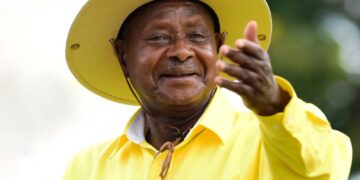







KAMPALA UGANDA: February 12, 2026— In a wide-ranging statement addressed to “Fellow Ugandans and especially the Bazzukulu,” President Yoweri Museveni has offered a historical retrospective of the National Resistance Movement’s (NRM) achievements while sharply criticizing both internal “careerist” leaders and the opposition for hindering the country’s progress.
Writing as “The Old Man with a Hat,” the President used the occasion of the nearly concluding election cycle to contrast the current political climate with the landmark elections of 1996. He argued that the NRM’s early success was built on solving “mikyeno” (societal needs), specifically citing the end of extra-judicial killings, the defeat of insurgencies like the LRA and ADF, and the 1987 launch of the Universal Immunization Program.
Internal Failures and “Eating Peace”
While celebrating the NRM’s historical “unanimity,” Museveni admitted that new challenges emerged that the government struggled to contain. He introduced the phrase “Tulya ddembe?” (“Do we eat peace?”), acknowledging a growing sentiment among Ugandans that physical security alone is insufficient without economic opportunity.
The President placed the blame for the slow implementation of pro-people policies squarely on the shoulders of local leaders.
”Many of the careerist leaders (nnonya-kulya) that were thrown up by the elections, were busy with salaries, allowances for themselves and never bothered with the implementation of those pro-masses policies,” Museveni stated.
He specifically noted that initiatives like Entandikwa (interest-free capital) and Universal Primary Education (UPE) suffered due to a lack of supervision and resistance from local PTA groups.
Energy Crisis and Political Friction
Museveni did not hold back in naming names regarding past infrastructure failures. He blamed the Parliament of the early 2000s, including Major-General Mugyisha Muntu, for the “load-shedding” (electricity shortages) that plagued the country. He claimed they blocked a deal with American investors that would have produced electricity at a significantly lower rate.
Turning to more recent events, the President alleged that the National Unity Platform (NUP) engaged in “cheating” during the 2021 elections. He claimed that the re-introduction of the secret ballot in 1994 allowed for the return of ballot stuffing and multiple voting—vices he claims the NRM had eliminated through “open lining” behind candidates.
A Call for “Principled Reconciliation”
Despite the harsh rhetoric toward political rivals, Museveni concluded with a call for national unity. He urged Ugandans to abandon “bad behavior” and work toward what he termed “principled reconciliation” rather than “opportunistic patching up.”
The statement ended on a deeply personal note, with Museveni marking the anniversary of a pivotal moment in his military career. He reminded citizens that on February 11, 1979, he crossed the Kagera River with 200 FRONASA fighters to begin the campaign against Idi Amin.
”As an NRA fighter, I am always with the fighters,” Museveni wrote.